
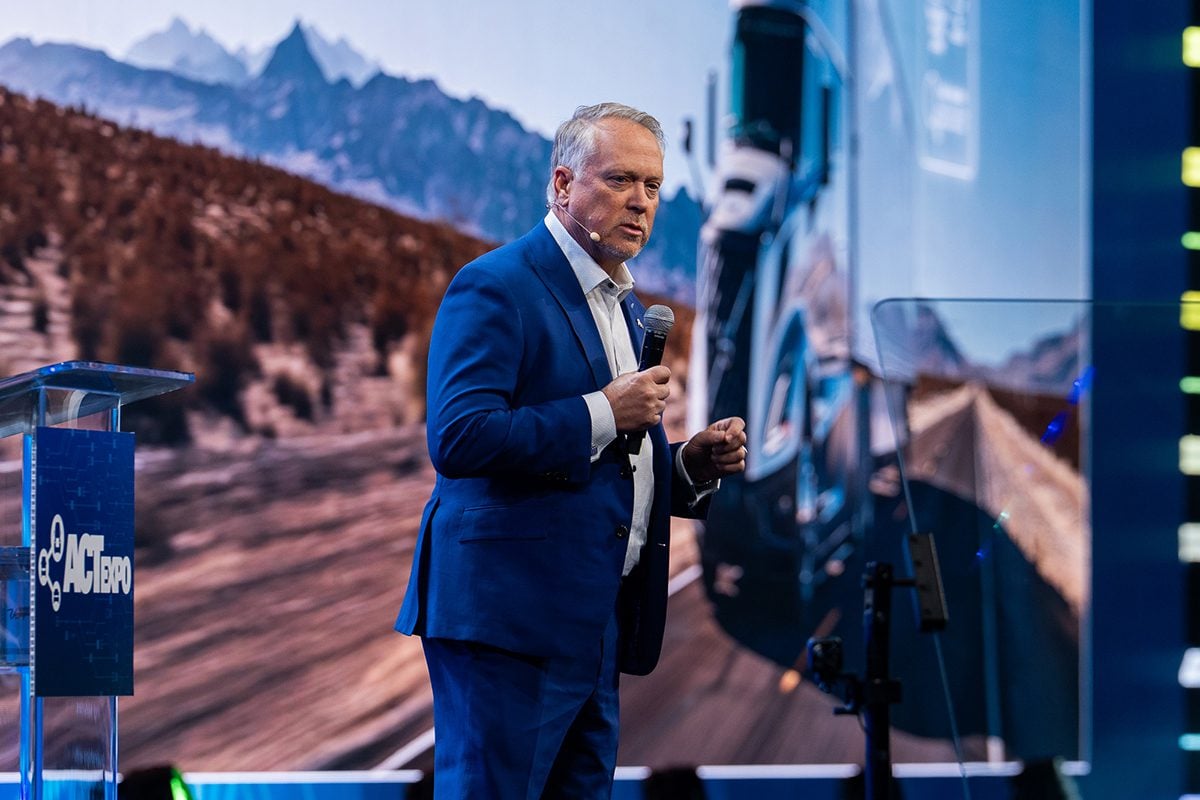
Stephen Roy used his ACT Expo mainstage keynote to make the case that the trucking industry is no longer defined only by steel, engines and drivetrains, but increasingly by software, data, connected systems and a broader view of sustainability.
Roy, president of Mack Trucks and chairman of Volvo Group North America, opened by acknowledging the uncertainty facing OEMs and fleets, from market and economic pressures to regulatory change. But he framed the moment as one of opportunity for an industry that has already transformed itself many times before.
“When most people think about trucking, they picture something old, dirty, slow, basically a necessary evil rolling down the highway,” Roy said. “But that’s not our industry anymore.”
Instead, Roy described modern trucking as an advanced industrial ecosystem, pointing to Volvo Group and Mack operations in Pennsylvania, Maryland, Virginia and North Carolina that rely on robotics, advanced manufacturing, digital quality systems and a highly trained workforce. He said the industry has moved from mechanical machines to electronically controlled powertrains, from paper logbooks to connected telematics, and now toward alternative fuels, battery-electric vehicles and autonomous heavy-duty trucks.
“Today’s trucks are intelligence on wheels,” Roy said. “Increasingly, what defines leadership in our industry is not just who builds the best trucks, it’s really who builds the best technology platforms and delivers complete end-to-end solutions for our customers.”
That technology shift, Roy said, must be paired with a broader definition of sustainability. While ACT Expo has long been a key stage for battery-electric vehicles, he said battery-electric vehicles (BEVs) are only one part of the strategy. In North America, Volvo Group has deployed the Volvo VNR Electric, Mack LR Electric and Mack medium-duty electric, with customers logging nearly 30 million miles on the VNR Electric alone. Globally, Roy also pointed to Volvo Construction Equipment’s electric product lineup, Volvo Penta electrification projects and more than 5,000 electric Volvo buses on the road.
“But let’s be clear, while BEVs are a critical piece of the puzzle, they are not the entire puzzle,” Roy said.
Roy said sustainability also includes hydrogen, renewable diesel and natural gas where they make sense, along with recycled materials, remanufacturing, parts reclamation, battery circularity and continued gains in internal combustion engine efficiency. He highlighted the newest Mack and Volvo long-haul trucks, which he said deliver up to 11% better fuel economy through advanced aerodynamics and optimized powertrain technology. According to Roy, if every new truck sold in the U.S. and Canada this year achieved an 11% fuel economy improvement, it would have the same impact as putting nearly 28,000 electric trucks on the road.
For fleets, Roy said sustainability cannot be treated only as a compliance obligation. It must also improve profitability through lower fuel use, reduced accidents, higher uptime, less waste and better driver retention.
“I challenge all of us to stop thinking about sustainability as a compliance issue, and instead think about it as a key contributor to competitiveness,” Roy said. “The most sustainable fleets will also be the most successful.”
That customer-focused approach, he said, is shaping how Mack and Volvo design vehicles and services. Fleet managers do not need more complexity in the cab, they need trucks that stay on the road, protect drivers and deliver predictable total cost of ownership.
The latest vehicle platforms reflect that change. Roy pointed to the fact that new Mack and Volvo vehicles have moved from six electronic control units to 27, enabling greater intelligence, flexibility and adaptability. He described those vehicles as the first step toward truly software-defined trucks, where more functions are shaped by software and real-world data rather than hardware alone.
Mack and Volvo were the first truck OEMs to offer automatic over-the-air software updates, according to Roy, a capability that can address thousands of issues before a truck reaches a dealer service bay. He said the connectivity platform has reduced unplanned downtime by roughly 25%, while proactive monitoring services have helped drive a 30% reduction in average repair times and a 96% “fixed right the first time” rate.
“In this world, a truck is no longer a standalone machine,” Roy said. “It’s a node on an intelligent ecosystem that includes your drivers, your shops, your OEM partners and your telematics platforms.”
Roy tied that technology roadmap to Volvo Group’s broader vision of being 100% safe, 100% fossil-free and 100% more productive. He said those goals are guiding investments in safety, decarbonization and operational efficiency, including efforts to improve load utilization through smarter routing, load consolidation and digital tools.
Those investments are substantial, Roy said, with Volvo Group investing more than $2 billion in new truck development, including Mack and Volvo platforms, and more than $1 billion to improve U.S. manufacturing locations in Pennsylvania, Virginia, Maryland and North Carolina.
“When people ask how can you afford to make these kinds of investments, my response is, how can we not afford to?” Roy said. “We choose to invest not just when times are easy, but through cyclical challenges as well.”
Autonomy was another focus of the keynote. Volvo’s view is that commercialized autonomy should begin with trucks purpose-built for the application, rather than retrofitted after production. He pointed to the Volvo VNL Autonomous, engineered with redundancies for critical safety functions and integrated with self-driving technologies at Volvo’s New River Valley plant in Virginia.
Volvo is already working with Aurora to deliver freight for customers like DHL and Uber Freight, including a new lane to Oklahoma, while also progressing with Waabi. As autonomy scales, he said, it can support longer continuous runs, faster ship-to-shelf timelines and more predictable operations.
Looking beyond highway applications, Roy also highlighted connected mapping and optimization tools for construction sites and vocational vehicles. By showing where vehicles are, what they are doing and how work can be sequenced, he said those tools can improve both safety and productivity in complex off-road environments.
Roy closed by pointing to software-defined vehicles as the next major frontier. He highlighted Coretura, the Volvo Group and Daimler Truck joint venture focused on building a standardized, open software-defined vehicle platform and commercial vehicle operating system.
The joint venture is not about creating a shared truck, according to Roy, with Volvo Group and Daimler Truck remaining competitors, but creating a shared digital foundation that can reduce duplication, accelerate innovation, improve safety and support seamless over-the-air updates.
His challenge to the industry was to invest not only in hardware, but also in data, software, people, common standards and new business models.
“If trucking is only 1% of what digital can do, imagine what the next 25, 50, 75% will mean for safety, uptime, sustainability and profitability,” Roy said. “Let’s not wait for the future of transportation. Let’s accelerate it together.”
This article was first published on ACT News.