
Artificial intelligence models have recently crossed a threshold. Commercial transportation is about to feel the impact.
Over the past several months, artificial intelligence hasn’t just evolved — it’s erupted. Entire sectors have been reshaped in real time. Software. Finance. Insurance. Healthcare. Media. Professional Services (legal, accounting, consulting). In each case, AI didn’t arrive quietly, nor slowly; it showed up overnight and landed with a thud.
The commercial transportation industry will not be immune – in many ways, it will likely be next.
Many of the conditions that make AI powerful in other industries not only already exist in fleet operations but are ever-increasing: digitally equipped and controlled vehicles, enormous data streams, complex decision-making environments, thin margins, and constant pressure to improve performance.
You may not agree with every point he makes, but the central idea is hard to ignore: the pace of capability improvement is startling, and accelerating as AI models continue to improve.
That sentiment — a sudden, seismic shift — is why we cannot treat AI as a distant future trend in commercial transportation. It’s already starting to shift the ground beneath our feet. In the last 12 to 24 months, we have seen important innovations and advancements in the use of AI in our industry.
- Routing decisions are being optimized algorithmically.
- Productivity and utilization is being optimized without human intervention.
- Maintenance schedules are moving from reactive to predictive.
- Service and replacement intervals are becoming dynamic versus fixed.
- Safety and operational performance is being monitored and improved in real time.
- Insurance underwriting and liability risk is informed by recorded data.
- Fueling and charging strategies are shaped by software and energy analytics.
- Workforces must be mechanically and digitally proficient.
We must also realize that the beginning of this digital transformation has only started to take place as AI capabilities have been improved and applied to the ever-increasing data systems and sensors found on today’s commercial vehicles. Like the world of datacenters, as more powerful and sophisticated chips (ECUs) become available and applied to commercial vehicles, the ability to monitor and control the vehicle, and gather and analyze data in real time, will only further accelerate. This shift has already occurred in the passenger car market.
We are truly in the first inning, and the speed of digital tech innovation continues to accelerate exponentially. Leading fleets are starting to harness this incredibly powerful technology and architecture to improve performance and productivity, reduce costs, and to differentiate themselves from their competition.
And this is precisely why ACT Expo 2026 matters more than ever.
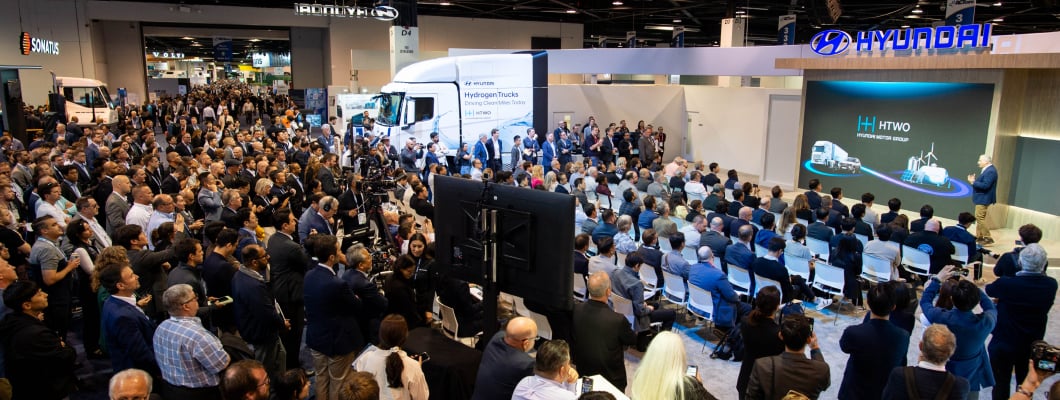
From May 4–7 at the Las Vegas Convention Center, ACT Expo — the largest fleet technology show in North America — will bring together the brightest minds and most consequential voices in our industry.
Advanced digital technology will be central to this year’s conversation, and the industry’s top thought leaders and experts of this revolution will be on the mainstage and technical tracks, and in the expo hall. These leaders are actively deploying connected vehicle systems, routing technology, predictive analytics, automation platforms, and AI-enabled operational tools at scale. They are not speculating about the future. They are building it.
ACT Expo 2026 will tackle the big questions that matter most:
- Is the digital frontier really here, and where can it provide real tangible benefits?
- When will these digital tools materially change fleet economics?
- Where will disruption arrive first?
- How will insurers, shippers, and regulators respond?
- What happens to fleets that ignore digital transformation?
ACT Expo has always been where progressive fleets plan what’s next. This year, that planning horizon is even closer.
The shift toward digitally enabled operations will not be gradual. It will accelerate as telematics, AI, predictive maintenance, safety, autonomy, energy optimization, and software-defined platforms converge. The fleets that understand how these systems integrate into their cost structure will gain structural advantages. The fleets that delay will spend the next decade trying to regain ground.
If you are responsible for safety, uptime, procurement, compliance, infrastructure planning, or long-term strategy, this is not a year to sit out.
The industry is moving faster than most realize.
Las Vegas is where you will see how fast.
This article was first published on ACT News.